
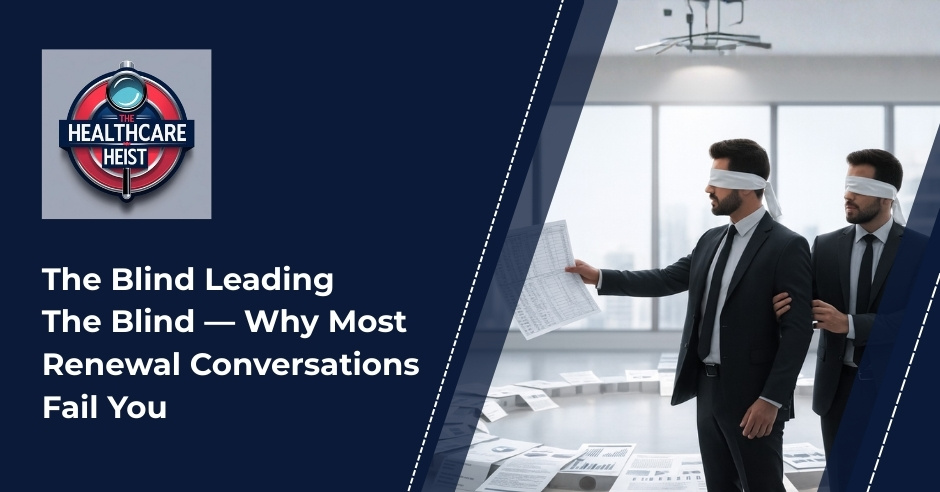
This episode rips the cover off one of the biggest myths in employee benefits: that your broker has everything under control. The truth? Most brokers only know what carriers want them to know—leaving employers in the dark about the data, options, and strategies that could truly transform their plans.
Join Lou Bernardi as he exposes how this lack of expertise and transparency keeps companies stuck on “renewal autopilot,” making decisions based on carrier spreadsheets instead of real insight. Lou also shares the essential questions every CEO, CFO, and HR leader should be asking to break free—and what happens when you finally stop letting the blind lead the blind.
If your renewal meetings feel rushed, shallow, or endlessly repetitive, you won’t want to miss this conversation.
—
Listen to the podcast here
The Blind Leading The Blind — Why Most Renewal Conversations Fail You
The Blind Leading The Blind: The Problem With Traditional Renewals
Welcome to our first episode of November. I can’t believe it’s November 7th, 2025. This year is flying. To my benefit friends that are out there, good luck. It’s been an interesting 4th quarter of 2025, to say the least. It’s promising in many ways. A lot of new prospects, a lot of new conversations, and a lot more involvement from the C-Suite we’re seeing here on our end. I am excited about the show. Before I forget to mention, if you’re out there and you’re connected with me or you have a story to tell, reach out to me on LinkedIn. I want to start having guests in the new year again for the show’s future episodes.
This episode is The Blind Leading The Blind – Why Most Renewal Conversations Fail You. You, meaning plan sponsors, members, and organizations that are sponsoring health insurance plans and falling victim to the healthcare heist. I call it the machine. It is a machine, but it’s one that can be fixed, like most machines. When you switch out the parts, you can supercharge machinery. Healthcare and health insurance are no different.
I know that my benefit advisor friends out there, doctors, clinicians, TPAs, and PBMs know what I’m talking about. Any of the plan sponsors that were represented at the Health Rosetta RosettaFest 2025 in Denver, Colorado, were promising. The turnout for the conference was amazing. The stories, the results, and the healthcare dividend that we talk about.
I wanted to talk about benefit sponsors and their relationships with their benefit brokers. Most companies have a benefit broker, advisor, consultant, or whatever that might be. They typically are working with the HR leaders and, hopefully, the C-Suite represented by the CFOs, CEOs, or anybody who is involved with this as a fiduciary in the health plan, which may not be familiar to a lot of people.
If you’re a plan fiduciary, someone who is involved in making that ultimate decision on what your benefits are, you should be in these meetings. These meetings need to be represented not only by members, but also by all levels of a business. Health insurance is strangling many companies out there. I know here in New York, in the small group market, which is businesses with 1 to 100 full-time equivalent employees, it’s a two-game town. It’s Oxford, which is a UnitedHealthcare company, and Anthem Blue Cross Blue Shield.
Most other carriers have dropped out of the market. As we enter 2026, Aetna is no longer a player. These carriers are all requesting 25% to 30% rate increases from New York State. In 2025, they were granted 10% and 12%, respectively, for Blue Cross and Oxford. We’re seeing increases in the 12% to 14% range. It’s not good for small businesses.
If you’re a 50, 60, 70, or 80-person company, you’re not a small business. You feel a lot like a big business. You’re competing with bigger businesses. You want to compete with those businesses. We want to get your mindset changed. If you’re in the benefits arena for as long as I have, and it is my 34th year, you are leaving a lot on the table.
Most employers are renewing and taking the path of least resistance, either because of perceived disruption or because they’re not getting viable solutions from their benefit brokers. We talk about it all the time. Everybody who is involved in the benefit decision, except for the employer and their members, benefits when prices go up, when claims go up, when premiums go up, or when commissions go up. Claims that are paid to providers increase their revenue. Insurance carriers can justify higher premiums when they pay out higher claims. That’s the picture we want to paint.
The C-Suite Disconnect & Budgeting By Arbitrary Numbers
For this episode, I’d like to talk about the blind leading the blind in healthcare renewals. Too many employers rely on advisors who only know what the carrier tells them. You don’t need to be a healthcare expert, but you do need someone who is. For plan sponsors, it’s a lot. We know that HR leaders are the busiest people at most organizations. CFOs are no less busy. They all have challenges, as well as CEOs.
The C-suite largely has turned its back on healthcare because it’s been groomed to believe that premiums and claims go up. Like death and taxes, they’re guaranteed. No financial information was shared. There was nothing for them to dig their teeth into, to make sound business decisions as they do in every other aspect of their business, so they’ve turned it over to HR and resorted to arbitrary budgets. They’re squeezing everything out of every other department within the business, and then determining what’s left over for our health insurance increase.
HR has to go back and work with brokers and get to that number. Often, they can’t get to that number from a premium increase, so it results in paying more and getting less, passing more cost onto employees in the form of premium contributions, increasing out-of-pocket costs, and watering down benefits somehow in order to find the money to get down to the budget.
Healthcare deserves and requires so much more than that. We know that CFOs, CEO, and HR leaders aren’t going to focus on this the way it deserves to be focused, unless there’s a reason to or unless they believe, “We’re getting ripped off. We didn’t know it was happening behind our health plan.” In order to show that, and in order for them to believe that healthcare deserves the time that’s precious to them and that they’re going to get something out of it either personally, professionally, or from a business aspect, they need to see that it’s happening. Far too often, they’re not getting the guidance.
I can speak, because I spent 25 years of my career as a general agent working with other brokers, which was pretty lucrative. I loved doing that for the first part of my career, which started about 1992 or maybe the end of ‘91. After the Affordable Care Act, something started to change. Technology companies, Zenefits, payroll companies, PEOs, and things like that were threatening our livelihood as benefit brokers. They were giving away technology and services in exchange for broker record letters.
Broker Expertise & The Shift To Value-Based Advising
I knew that unless we did that, myself for my own book of business, but also for the brokers I served, and upped our game and started providing additional services, we were going to lose those clients. Strangely enough, most of the brokers I worked with weren’t interested in doing that. They didn’t see that as their role. Similar to what happened in 1992 when New York took on community rating, a lot of brokers stepped away. It wasn’t a big part of their practice. Most of them, honestly, were not benefit brokers. That’s why they worked with general agents.
Most brokers out there that are selling insurance are not benefit advisors. They’re property casualty brokers. They’re financial planners. They’re life insurance specialists, but they have a clientele that needs benefits. For a very long period of time, that was adequate. They could reach out to a general agent like me. We could package. We could quote go-to-market. We could put insurance quotes in front of their clients. If you could do better, a lot of times, you’d get the business.
That worked for a long time, but I saw the writing on the wall. I knew the technology benefited administration and the new compliance, which started with 1094 and 1095 tax forms because of the applicable large employer mandates. I jumped into that and left the GE world back at the end of 2016 to focus exclusively on my own agency.
I can say with a pretty fair degree of accuracy that most brokers are selling insurance. They have not seen the prices behind the scenes. They’re not familiar with price transparency. They haven’t seen the prices. They haven’t identified the crisis that we’re in in the US, where the consumer of healthcare and health insurance is largely in the dark.
If you think about everything else you do in your company and you can see it, feel it, and analyze it, make business decisions, and change vendors from office equipment to real estate brokers and things of that nature, you know what you’re getting. You have the prices. You can see the quality. You can get results. With healthcare, most people have no idea what they’re paying for. It feels like you’re buying insurance, but you’re not buying insurance at all. You’re financing the healthcare risk of your employees.
It’s probably the 2nd or 3rd largest investment you’re making as an employer in your people. It should be a benefit. We call it an employee benefit, but does it feel that way to your team, or is it more of a nuisance? Is it something that HR looks favorably on and wants to spend time at open enrollment, building a high-performance health plan to deliver to their employees? Do they want to measure it? Do CFOs want to get back into this? Do they see an opportunity?
If you could look at whatever your healthcare investment is, on average, for every 100 employees that are covered under a plan, you’re probably looking at a $2 million healthcare spend or more. It is a factor of how many singles, families, couples, or things of that nature are in your plan. The demographics and the region that you might be in are going to dictate that.
If you look at your healthcare investment today, on average, for every hundred employees covered under a plan, you’re probably spending $2 million or more. Share on XIf you’re a 500-person company, you’re probably paying close to $8 million or more for your health insurance premiums. If you’re fully insured, you’re going to get some data. You’re going to get some claims data. You’ll get a premium versus claims report. Are you seeing what you’re paying for individual services? Have you ever seen that?
Why does this matter? It’s because renewals happen fast. The health insurance companies generally release renewals 60 to 120 days. The larger the company, the earlier you can dictate the release of your renewal. Unless you request early renewals in advance, you’re usually looking at a 90-day period. That is not a lot of time. The broker, generally, will get the renewal. They may or may not share that renewal at all with the plan sponsor. The plan sponsor may not be interested in seeing it because as soon as it’s dropped on their table, they’re involved. It takes part of their focus, that time investment that I mentioned.
Renewals happen fast, and everybody benefits when they do. Your broker wants a quick renewal. Your broker is looking to do as little as possible, like plan sponsors. No one wants disruption and change, but often, that is dictated by the renewal. You may get 30%, 40%, or 50%. I’ve heard as much as 124% rate increase on group health plans. PEOs are notorious for terminating groups at renewal because they’re not favorable, and it hurts their book of business.
What are you going to do when that renewal drops on your desk, and you’re faced with a 40% increase in 2026, 2027, or 2028? You’re going to be reactive, not proactive. Most brokers aren’t looking to do work early either. This matters, what we’re talking about, because unless you’re lining up your healthcare with your business goals, mission, growth strategy, and exit strategy, you’re going to be a sitting duck.
Employers make big decisions with very little information. Time and time again, you get a renewal. Here’s a renewal. How does that look? Is that suitable for your CFO? Are we close enough so that we can get to that target number? We still do this, and we don’t like doing that. We want to talk about the expected claims cost. That’s where we want to get because the expected claims cost is the building block for your health insurance plan.
Whether or not you’re fully insured or whether you’re fully insured or self-insured, that expected claim is everything. That’s where the focus can be. That’s the building block for your plan. If you can reduce your expected claim cost, you’re going to reduce the insurance cost to finance that risk, because that’s what insurance is. You’re financing that risk because you don’t want to take it on all by yourself. You need insurance companies, potentially, or you need stop loss insurance carriers. You need reinsurers.
Brokers aren’t always equipped to guide you. I’m working on a book. It should, hopefully, soon be released. I’m going to provide benefit guides. I’m going to provide clear guides for CEOs, CFOs, and HR leaders to sit down with their brokers to sniff out what is happening. How much do their brokers know? Are their brokers following what’s happening?
This AI-powered healthcare and health insurance is about to hit warp speed. From 2024 to 2025, we’ve seen amazing strides with the support that we can provide and the access to information that we can get in order to pinpoint what the healthcare risk is of a small population. It is down to as few as ten people with a high degree of accuracy.
We’ve been able to, with the assistance of this AI-powered generated tool, deliver renewals that are 30% to 40% below the New York community rates. It has surpassed $4,000 a month for a family for silver plans. Silver and gold plans are $4,000 a month here, if you can believe it. Gold plans are $1,400 a single in New York, with nowhere for employers to go.
We can help with that, but we need employers who are looking for more. The results, when you do it the old-fashioned way, are higher costs, confused employees, and no progress. Year after year, there will be higher premiums, fewer benefits, lower wages, lower take-home pay, and more vulnerable high-cost claimants and frequent flyers.
In one sentence, I would say most employers and most brokers are navigating a broken system with the same blind spots. We want to remove those blind spots, but you have to want to see it. You have to understand that this isn’t about working harder on your healthcare and health insurance. This is investing time into your healthcare and health insurance. If you’re an HR leader, we want to make talent acquisition easier and more efficient. We want to make your benefits something that you can highlight instead of hide from your employees. That’s all possible. You do not have to settle for paying more and getting less every year.
Most employers and brokers are navigating a broken system with the same blind spots. We want to remove those blind spots, but you have to be willing to see them. Share on XSometimes, these AI analyses identify that claims are significantly higher than an employer would’ve imagined for their employees. They have a lot of high-cost claimants. Self-insurance isn’t the end-all, be-all for them. Maybe they feel a little bit better that a fully insured plan that’s not experienced rating them is a safer place to be.
If you have 100 employees on your plan or greater, then you’re almost certainly experience rated. You should be getting some information, but you’re not getting adequate information. You’re not getting any claims data to give you any visibility for you to make informed, strategic business decisions. If that sounds like what’s happening to you, you can’t settle for that.
The Three Essential Questions Employers Must Ask
Here are three simple questions employers should ask. One is, “What do we know about our plan?” If the answer is, “Not too much,” that’s a red flag. When I say your plan, I don’t mean, “Do we know what our copays are? Do we know what our deductibles are? Do we know what our ID card looks like? Do we have phone numbers?” What do you know about your insurance carrier? Do you know who your insurance carrier is and who their sister companies are? Do you know what the framework of that insurance carrier is?
Are they also your pharmacy benefit managers who are profiting significantly as your broker for prescriptions, making huge rebates in spread pricing on prescription medications? Are they also your doctors? The largest insurance company in the country is also the number one employer of doctors. In their directories, they designate those doctors as preferred much of the time, which makes you think that maybe they’re the best doctors. They’re not the best doctors. They’re the doctors they want you to see, because guess what? When they buy these doctors’ offices and become the healthcare system, they don’t drop the prices. They’re not making it more cost-effective.
That’s why they want to get into healthcare. They want to get into healthcare because they know that’s the next horizon for them. That’s where they need to go in order to continue to maximize their profits as an overall arching business. Maybe not your insurance company. They’ll pretend to lose money on your insurance, justify higher premiums, and make buku money behind the scenes.
Question number two. Are your people truly getting support when they need it? Not just an 800 number, but real help and real navigation. High-performance health plans don’t rely on insurance companies or the healthcare systems to help people get to the best doctors. They won’t do that. They’ve told me they won’t do that. They hide behind the fact that all of the doctors work for us. All of the doctors are in our network, so we can’t drive people to the best doctors. What they mean is the best doctors don’t make us the most money. They don’t fill our beds. We don’t pay the highest claims to the best doctors.
The best doctors treat people the best with the best outcomes, but also provide the most appropriate care. That’s what you should be looking for. This is not groceries. This is not computers or TVs. You can’t return this to Amazon when you buy it, and you don’t like the healthcare you’ve provided. You can’t return healthcare, and you can’t get out of that bill. When you’ve signed that paperwork in the doctor’s office, you’re agreeing to pay them in full, at least up to the allowable rates if they’re in the network. If you’ve seen a bad doctor and have gotten a bad surgery, you don’t get that money back.
Real navigation helps people, generally with nurse advocates and care coordinators, get to the best doctors, not after the care is provided, but before the care is provided. It reaches out to members before they receive the care. There are triggers for this. Pre-authorization is a trigger. Every scheduled surgery in the country requires pre-authorization, for the most part. Advanced radiology requires pre-authorization under most plans. This is an opportunity for a nurse to get triggered or get a little notification, like, “We have Jane Doe from ABC Company going in for this procedure.”
Nurses are the most trusted profession in the world. Nurses reach out to the member and say, “I’m Nurse Sam or Nurse Angela from your navigation company. We understand that you’re going in for this procedure. We’d love to talk to you and prepare you for your surgery. We’d love to answer any questions and prepare you for post-surgery.
When you go home, we want to know about your situation. Do you live alone? Who’s going to care for you? Did your doctor talk to you about this post-surgery? What do you know about your doctor? Would you like us to provide some guidance on who the best doctors are, the doctors who are providing these services most appropriately, but also getting the best results when they need to be done?”
Question three. Are we any better off than in 2024? If the plan never improves, who is it serving? I ask employers all the time to connect with me, and they say, “We got through renewal, so it’s not a good time. We’ll talk again next year. Give us a call in October for our January renewal.” I say, “I want to talk to you now. While it’s fresh in your mind, I want to talk about your experience this year. Was it 100% focused on your insurance cost?
Are we any better off than last year? If the plan never improves, who does it really serve? Share on XDoes your renewal strategy this year give you reason to believe that next year’s results will be better, that your employees will be better served for the next twelve months before your next renewal? Can you control costs? Will you get more insights into your plan? Are the benefits that you’re purchasing serving your employees’ needs?”
Too many employers have been forced to increase out-of-pocket costs year after year since managed care has been the predominant insurance in healthcare delivery systems in the US. The $5 and $2 copays from the early ‘90s are $5,000 and $10,000 deductibles or higher on health plans. When most Americans have less than $1,000 in the bank, that’s a recipe for disaster. A lot of people are working to have healthcare, especially if you’re not 65 yet, when you can hope to get Medicare.
When you have a renewal, when you have this $5,000 and $10,000 family deductible that resets every single year with no help with that out-of-pocket cost, you feel like you’re on an island. Maybe you feel silly going to your HR. Maybe you’re not hearing these complaints from your employees if you’re an HR leader or a CFO, but I am. That’s because I’m the one who’s delivering these messages that open enrollment. I’m staying behind, talking to employees, and hearing the hardships.
What we’re hearing is that the strategies that we’re implementing are better serving those hardships. That’s what’s given me so much energy the last few years to do what I’m doing because we can help. We can not only help the HR teams and businesses use their insurance to attract and retain the top talent and highlight their benefits when they’re looking for that next key employee. We can also help the people who were experiencing $5,000 and $10,000 deductibles, which were swept away by a new health insurance plan, so they have first-dollar benefits with no out-of-pocket cost. For them to have simpler benefits that they understand with people behind the scenes who are supporting them to get the most out of their healthcare, that’s transformative.
What Good Looks Like: Visibility, Support, & Transparent Partners
HR takes notice of that because people are lining up at their door and saying, “This is fantastic.” It could be working with an old insurance plan and then supplementing it with some resources, or building a new health insurance plan from the bottom up with best-in-class solution partners, the best TPAs out there, best PBMs, care navigators, and companies that are helping to combat the cost of GLP-1 medications, infusions, injectable medications, dialysis claims, and things like this. We’re talking about people. We’re talking about their health.
What does good look like in a health plan? What should you be looking for at renewal? You should be talking about better visibility with your broker. How can we see more about what our health plan is? Where is the money going? What are we paying for? Better support for your most vulnerable members and better partners who understand the system and whose missions are aligned with yours. These people aren’t making money under the table, but, very transparently, a flat dollar per employee or per member per month.
Transparent pricing, so you know who your benefit partners are. Sometimes, it’s performance-based, and sometimes, it’s not, but at least you know that you’re working with people who can be identified and can be replaced. You can’t replace your PBM if you’re working with a traditional health insurance carrier. They have their partners, as many as 2,700 affiliates, with the largest insurance carrier in the country. That’s who your health insurance is.
You might think you’re working with one entity. You’re not. You have an ID card that has 1 label, 1 logo, and one 800 number for you and for providers to call. You have a group policy number and a bid number for your pharmacy. You’re working with hundreds of third-party companies that your insurance companies have contracted with and probably making a piece of the pie there, up to 2,700 if you can believe that.
Can you expect better outcomes for your people and your budget? If your health plan isn’t lining up to do that, then you are accepting the fact that this is going to go up 10% to 15% every single year. It will, and it will get worse. Every employer that is finding a different solution leaves the people that are left behind paying more to maintain that Wall Street stock price. Investors want returns. They want profits. They want growth. That growth is coming at the expense of the people who are uninformed and staying behind.
For the positive part of this, why make these changes to begin with? Employees get guidance, not guesswork. Employers finally see what they’re paying for, which are actionable insights. The plan starts improving instead of repeating the same problems. You’re not going to fix it all at once, but when you have actionable insights, you have information in your plan that tells you what the next thing is that requires our attention. It tells you how we can better serve our employees, how we can better control our costs, and whether the partners that we’ve selected to work with are performing to the standards that they’ve provided us with. These are all possibilities.
It sounds like it might be a lot more work for HR, CFOs, and CEOs. It’s not. This is happening behind the scenes, often using AI, which is unbelievable. This is an example of how to use AI to extract huge amounts of data to identify the best providers and determine whether your PBM is performing, whether you’re getting rebates, or whether you’re paying the manufacturer’s price, plus whatever the markup was that you agreed to in your plan.
The other positive thing is that leaders regain control instead of reacting every year. They can start making smart decisions for their business. Everyone benefits when the right people are leading the way. We know that HR, CEOs, and CFOs are doing the best that they can, but they’ve been groomed to think that there’s nothing that can be done about this at all.
They don’t even want to spend the time investing in it because they think they’re going to get smoke and mirrors or some snake salesperson is going to walk through the door. It’s not that when you can demonstrate and show, “These are capabilities, this is the information that’s out there. Would this help you make smarter decisions? Would this type of benefit change be beneficial to your employees? Would it help you attract the best talent and keep it?”
As a closing message, you don’t need to know everything about healthcare. You do need to work with people who are learning more about healthcare and health insurance, who understand the components of your health plan, and who truly understand who your health insurers are and what the capabilities of this alternative ecosystem of healthcare and health insurance can be. Are they going to conferences? Are they getting on Zoom calls? Are they talking to other advisors?
We’re doing a lot here at BritePath. We’re starting conversations year after year with employers. Often, we’re the first person that even had this conversation with the CFO or the CEO. They knew nothing about this. Sometimes, they’re still leery to get involved. One told me, “That’s amazing. I knew nothing about any of that stuff. I can’t believe that that’s possible, but I’m not getting involved.” They will get involved, but they’re not getting involved this year. I asked them why because it was such a positive conversation. The answer was, “If I get involved, I own it.” They don’t want to own it because it’s outside their comfort zone.
The comfort zone is one of the biggest obstacles here. It’s easy to renew. It’s easy to water down benefits. It’s easy not to submit new enrollments, ask employees questions, and survey your employees. It’s easy to build a plan that’s good for your key employees, but it’s hard work to serve all of your members. It’s hard to work for the advisors who are willing to do this behind the scenes for you.
There are hundreds of advisors out there that I know personally who can step up, step in, and provide some insights, some guidance, and alternatives to the traditional healthcare systems that can help employers begin to build a high-performance health plan. It doesn’t have to happen all at once. It doesn’t have to be disruptive. It’s a conversation that needs to start, and once it starts, usually, there’s no stopping it.
There’s a healthy animosity towards health insurers and your health systems. Health systems are equally at fault here as the health insurance companies, don’t get me wrong. They’re maximizing profits. They’re using the doctors who work for them. They’re burning out doctors, especially the primary care doctors. They’re using doctors to steer patients towards where the care generates the most profit for their healthcare system, without providing the doctors with the insights into cost.
Good doctors don’t want their patients to suffer physically or financially. As more doctors start to understand what’s happening behind the scenes of healthcare and health insurance, more and more of them are trying to leave the dark side and come over to the transparent side. There are direct primary care doctors and direct contracting doctors who no longer want to work with health insurers but want to work with insurance companies, plan sponsors, and advisors who are trying to get people to go down another route.
You need the right guidance. When you get that, everything changes, whether it be cost, quality, or employee experience. Culture changes. When you get the right guidance and start to open your eyes to what’s possible, you see the domino effect of the positive change it can make, not only on your healthcare spend and your premiums, but every other aspect of your business.
You can pay more. Paying more can help get talent. You can reinvest more into pensions and profit sharing. You can invest in a company. You can get the money that you need for that next loan that you want to take to expand your business. We’ve seen this personally. If you’re a company that’s looking for an exit strategy and you have a 5 to 10-year exit strategy, dealing with your health insurance can pay huge dividends in the future.
For most employers, do they know what they’re renewing? Do most brokers have the tools or data to guide them? Lastly, when you finally get a real expert, your costs go down, and your employees get the support they deserve. I know that that’s what every HR leader out there is looking for. You might be working with a broker who provides great service at renewal. They’re great. They pick up the phone and help you. They’re an extension of your HR team.
In this day of AI and transparency, that is not enough. You need brokers who are willing to do the work and willing to step out of their comfort zone to provide you with the solutions, resources, and benefit strategies that you need to make smarter decisions now and for many years to come. That concludes this episode of the show. I’d love to hear what you think. Thank you so much. Have a wonderful fourth quarter. I hope to talk to you soon.
Important Links
- Louis Bernardi on LinkedIn
- BritePath on LinkedIn
- The Healthcare Heist – Rise of the American Healthcare Consumer on Apple Podcasts